Which Fast Charger Is Best: Match PD or PPS, Not Watts, Picks From ₹502 (2026)
Smartphones & Gadgets 13 min read By Pragya Singh
In this articleTable of contents11
Last updated: 8 November 2026
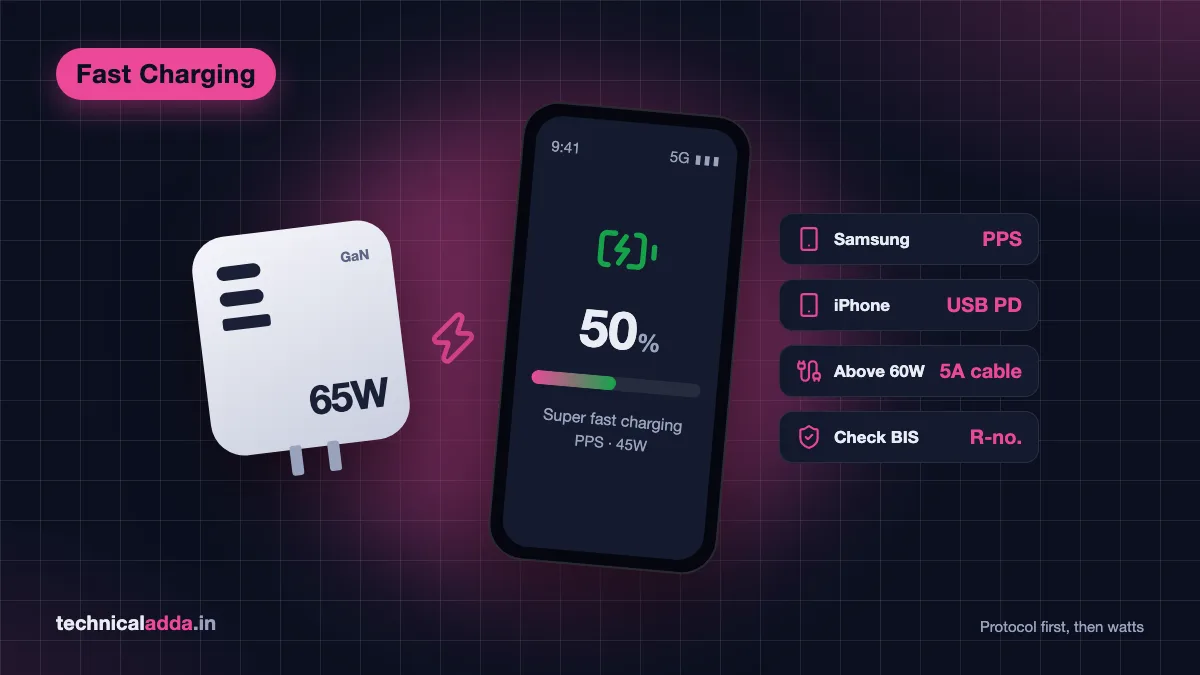
Which fast charger is best? The one that speaks your phone's charging language. For a Samsung Galaxy, that's a 25W or 45W PPS charger; for an iPhone, a USB-C PD charger of 20W (iPhone 12 to 16) or 40W (iPhone 17); for OnePlus, Oppo or Xiaomi, the brand's own brick and cable. If you want one charger for phone and laptop, buy a 65W GaN charger with both PD and PPS.
A bigger number on the box doesn't make your phone charge faster. A 120W charger can still charge a Samsung at 10W if the two can't agree on a protocol. Below we explain how fast charging works in plain words, which charger suits each phone brand, Amazon.in prices checked on 30 October 2026, and how to spot a fake "original" Type-C charger.
Quick answer: The best fast charger is one that matches your phone's protocol: USB PD for iPhone and Pixel, PPS for Samsung, SUPERVOOC or HyperCharge for OnePlus and Xiaomi. Good picks: Samsung 25W (₹502 to ₹849), Apple 20W (₹1,699), and a 65W GaN charger with PD and PPS like the Portronics Adapto 65M (₹1,099) for every device.
How fast charging works
Fast charging means pushing more power (watts) into the battery. Watts are volts multiplied by amps. An old 5V, 1A charger gives 5W. A fast charger raises the voltage, the current, or both: 9V at 2.22A is 20W, and 10V at 4.5A is 45W.
The phone and charger first "talk" over the cable to agree on a safe voltage. This handshake is called a charging protocol. If both support the same protocol, you get fast charging. If they don't, they fall back to a slow, safe 5V mode.
The protocols you'll see on boxes in India:
- USB Power Delivery (PD): the universal USB-C standard. iPhones, Pixels, laptops and most Android phones use it.
- PPS (Programmable Power Supply): part of USB PD 3.0 that adjusts voltage in tiny steps. Samsung's "Super Fast Charging" needs PPS.
- Qualcomm Quick Charge (QC): older Android standard, mostly on USB-A chargers.
- Brand-only systems: OnePlus, Oppo and realme use SUPERVOOC; Xiaomi uses HyperCharge; Vivo and iQOO use FlashCharge. These reach 80W to 120W only with the brand's own brick and cable.
GaN (gallium nitride) is not a protocol. It's a chip material that lets a 65W charger be the size of an old 20W one and run cooler. Most good chargers above 30W now use GaN.
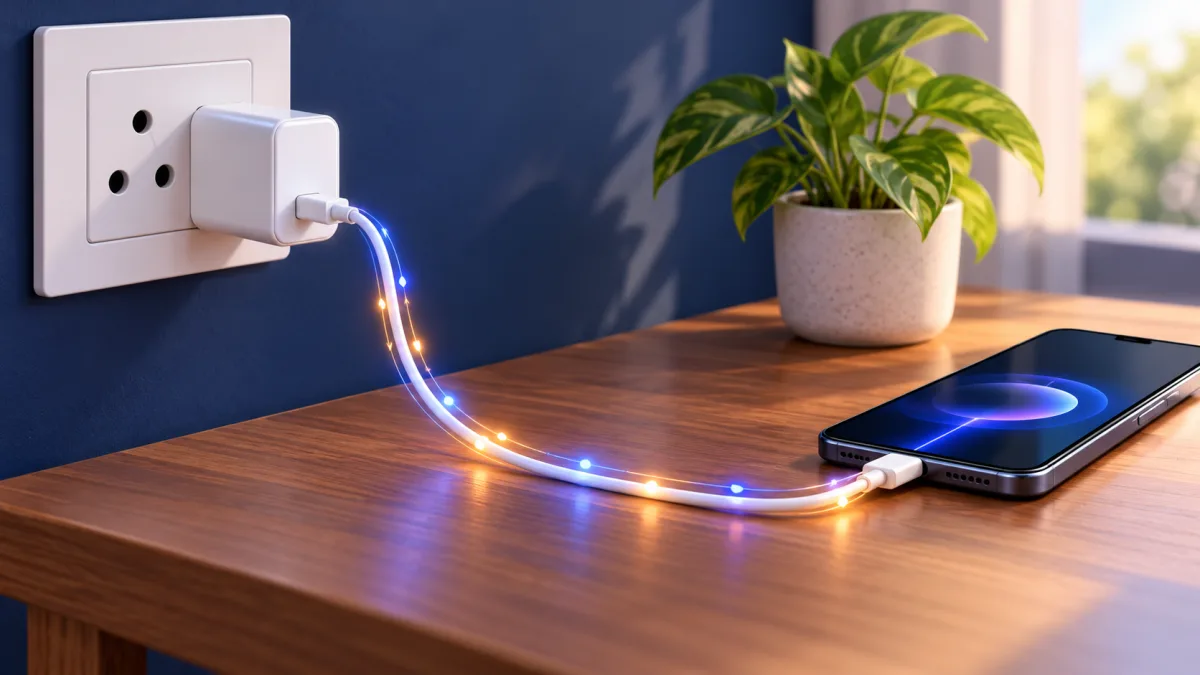
The phone and charger agree on a protocol first, and fast charging only kicks in when both support the same one.
Fast charger vs normal charger
A normal charger gives 5W to 10W at a fixed 5 volts. A fast charger gives 18W or more by negotiating higher voltage with the phone. On a 5,000 mAh phone, a 10W charger needs around 2.5 to 3 hours for a full charge, while a 25W charger gets you to about 50% in 30 minutes and full in a little over an hour.
| Point | Normal charger | Fast charger |
|---|---|---|
| Power | 5W to 10W | 18W to 120W |
| Voltage | Fixed 5V | 5V to 20V, negotiated |
| Port | Often USB-A | Mostly USB-C |
| Protocol | None | PD, PPS, QC or brand-only |
| Full charge (5,000 mAh) | About 2.5 to 3 hours | About 40 to 80 minutes |
| Heat while charging | Low | Higher in the first 50% |
Fast charging is fastest from 0 to about 50%. After 80%, every phone slows down on purpose to protect the battery, so a 45W and a 25W charger finish the last 20% at similar speed.
How many watts charger does your phone need?
Buy a charger that matches your phone's maximum supported wattage, or higher. A higher-watt charger is safe because the phone only draws what it can take, but you get no extra speed beyond the phone's limit.
| Phone | Fast charging standard | Max wired speed | Charger to buy |
|---|---|---|---|
| iPhone 17 series | USB PD | 40W (Apple: 50% in 20 min) | Apple 40W Dynamic or a charger listing iPhone 17 40W support |
| iPhone 12 to iPhone 16 | USB PD | About 20W to 27W | 20W or 30W USB-C PD |
| Samsung Galaxy A and M series | PPS (Super Fast Charging) | 25W | 25W PPS |
| Samsung S25 Ultra, S25+ | PPS (Super Fast Charging 2.0) | 45W | 45W PPS with a 5A cable |
| Samsung S26 Ultra | USB PD 3.1 with PPS (Super Fast Charging 3.0) | 60W | Samsung 60W adapter |
| Google Pixel | USB PD with PPS | About 27W to 45W by model | 30W to 45W PD PPS |
| OnePlus, Oppo, realme | SUPERVOOC | 45W to 100W+ | The in-box brick and cable |
| Xiaomi, Redmi, Poco | HyperCharge / turbo | 33W to 120W | The in-box brick and cable |
Apple's figure comes from the iPhone 17 tech specs (opens in new tab): up to 50% in 20 minutes "with 40W adapter or higher". Samsung's 60W adapter page (opens in new tab) lists Super Fast Charging 3.0 for the Galaxy S26 Ultra and later.
Not sure what your phone supports? Search your exact model on the brand's site or check Settings > About phone > Battery. Many budget phones now ship without a charger in the box, which is why this question comes up so often.
Which fast charger is best for your phone brand
Samsung Galaxy: PPS is a must
Samsung's Super Fast Charging only works with PPS. A plain 20W PD charger (like Apple's) charges a Galaxy, but at normal speed, not "Super Fast". Look for "PPS" in the listing; "PD" alone isn't enough.
- Galaxy A and M series: 25W PPS.
- Galaxy S Ultra and Plus models: 45W PPS with a 5A cable. The S26 Ultra goes up to 60W with Samsung's 60W adapter.
iPhone: USB-C Power Delivery
Every iPhone from the iPhone 8 onwards fast charges over USB-C PD. For iPhone 12 to 16, a 20W PD charger gets you close to full speed; a 30W one adds a little on Pro Max models. The iPhone 17 series can take 40W. Apple's own 40W Dynamic Power Adapter (sold as "with 60W Max") is built for it, and a random 65W charger may not reach Apple's 20-minute figure. For that speed, buy Apple's adapter or a third-party one that clearly lists iPhone 17 40W support.
OnePlus, Oppo, realme, Xiaomi, Vivo: keep the box charger
These phones reach 80W or more only with their own brick and cable. Plug them into a generic PD charger and most drop to somewhere around 18W to 30W, depending on the model. That's still fast enough for daily use, but slower than the box charger. If you lose the original, buy the same brand's adapter from its official store or a big retailer.
One charger for everything: 65W GaN with PD and PPS
If your home has a Samsung, an iPhone and a laptop, buy one 65W GaN charger with at least two USB-C ports, PD and PPS. It charges a Type-C laptop, fast charges both phones, and replaces three bricks. Check the "single port" and "multi-port" wattage split in the listing, because 65W is shared when two devices are plugged in.
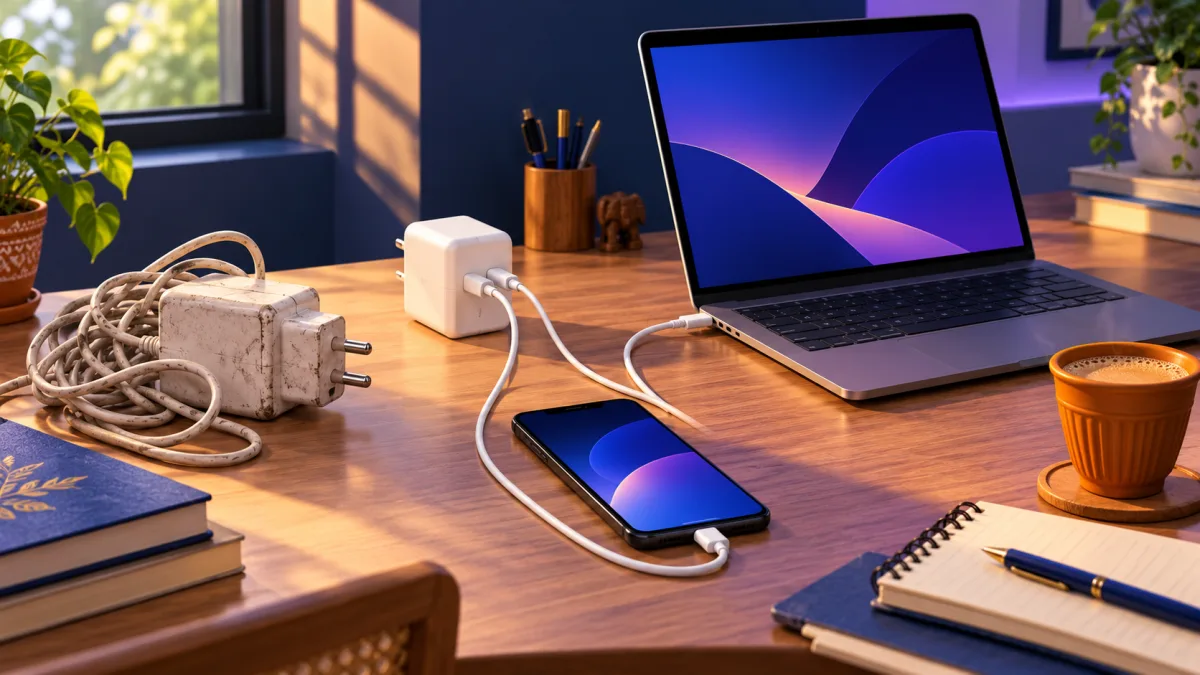
One small GaN charger with PD and PPS can charge a phone and a laptop from a single socket.
Best fast chargers in India right now
Prices are Amazon.in selling prices checked on 30 October 2026, during the festive sales, GST included. They change daily, and several "brand" listings are sold by third-party sellers, so check the seller name and the price before you pay.
| Charger | Price | Max output | Protocols | Best for |
|---|---|---|---|---|
| Portronics Adapto 65M GaN | ₹1,099 | 65W (2 Type-C, 1 USB-A) | PD, PPS | Best value, all devices |
| Spigen PE2302 65W GaN | ₹1,994 | 65W, 45W PPS on one port | PD, PPS | Samsung S series plus laptop |
| Samsung 25W Travel Adapter | ₹502 to ₹849 (no cable) | 25W | PD, PPS | Galaxy A and M series |
| Samsung 45W Travel Adapter | ₹899 to ₹942 (no cable) | 45W | PD, PPS | Galaxy S Ultra and Plus |
| Ambrane 33W GaN | ₹649 | 33W | PD, PPS | Budget pick for most phones |
| Apple 20W USB-C | ₹1,699 (Apple MRP ₹2,190) | 20W | PD | iPhone 12 to 16 |
| Apple 40W Dynamic Power Adapter | ₹4,249 (Apple MRP ₹4,900) | 40W (60W max) | USB PD | iPhone 17 at full speed |
Samsung's adapters vary by seller, so we show the range we saw. MRPs for the Apple adapters are from Apple's India store on the same day.
1. Portronics Adapto 65M GaN: best value for most homes
At ₹1,099 this is the cheapest 65W GaN charger from a known Indian brand that we found with two Type-C ports, a USB-A port, PD and PPS. It can charge a Type-C laptop and a phone together. On 30 October 2026 Amazon.in showed no main Buy button for it; the ₹1,099 offer (sold by Cocoblu Retail) sat under "See All Buying Options".
- Watch out for: a 3.8-star average from about 700 ratings. Fine for the price, but not the most polished pick.
2. Spigen PE2302 65W GaN: best for Samsung flagships
The Spigen gives 45W PPS Super Fast Charging to a Galaxy S Ultra when used on a single port, and its listing says it's BIS certified and weighs 140 g. It costs ₹1,994 (MRP ₹2,499), sold by Spigen India.
3. Samsung 25W and 45W Travel Adapters: safest for Galaxy phones
Samsung's own 25W adapter (₹502 to ₹849 without cable, ₹842 with cable) and 45W adapter (₹899 to ₹942 without cable) are what Samsung designs its phones around. Both support PPS. On Amazon they're sold by third-party sellers, so pick a listing with thousands of ratings and a clear warranty, or buy from Samsung's own store or a Samsung Smart Café.
4. Ambrane 33W GaN: best budget fast charger
At ₹649, the Ambrane Charge33 has PD and PPS on a USB-C port, which covers iPhones, Pixels and Samsung's 25W mode. It won't hit Samsung's 45W, but for most mid-range phones that's no loss.
5. Apple 20W and 40W adapters: for iPhone owners
The Apple 20W USB-C adapter costs ₹1,699 on Amazon.in (Apple India's MRP is ₹2,190) and suits iPhone 12 to 16. For an iPhone 17, Apple's 40W Dynamic Power Adapter (₹4,249 on Amazon.in, MRP ₹4,900 on Apple's India store) is the sure way to get the advertised 50% in 20 minutes. Both are sold by an authorised reseller on Amazon; neither includes a cable.
Charging a laptop too? A 65W GaN charger often replaces the bulky brick that ships with it. Our laptop guide for B.Tech CSE students notes which laptops charge over USB-C.
The cable matters as much as the charger
A good charger with a weak cable charges slowly. Most basic USB-C cables carry up to 3A, which is enough for 60W. Anything above 60W, and Samsung's 45W mode, needs a 5A cable with an e-marker chip that tells the charger it's safe.
- Use the cable that came with your phone when you can.
- For Samsung 45W, buy a cable that says "5A" in the listing.
- For SUPERVOOC and HyperCharge, the brand cable matters even more. A generic cable drops most of these phones to normal speed.
- Replace any cable with a loose plug, bent pins or exposed wire.
If your phone shows "charging" but the percentage barely moves, the cable or the port is usually the problem. Our phone not charging fix guide walks through cable, port, water and software causes one by one.
Does fast charging damage the battery?
No, fast charging doesn't meaningfully damage a modern phone battery on its own. Heat is what wears a battery out, and phones slow fast charging as the battery warms up and as it passes 80%.
In a two-year, 40-phone test by YouTube channel HTX Studio, Android phones charged at 120W ended up only about 0.3% apart in battery health from phones charged at 18W after 500 charge cycles, as Android Central reported (opens in new tab). Phones kept between 30% and 80% finished about 2.5% healthier than phones run from 0% to 100%.
What actually helps your battery:
- Avoid heat. Don't charge under a pillow, in a hot car or while gaming. See our guide to the phone heating problem for more.
- Turn on the battery protection setting. Samsung, iPhone and most Android phones can stop at 80% or learn your routine.
- Use a proper charger. A fake charger with poor voltage control does far more harm than any genuine fast charger.
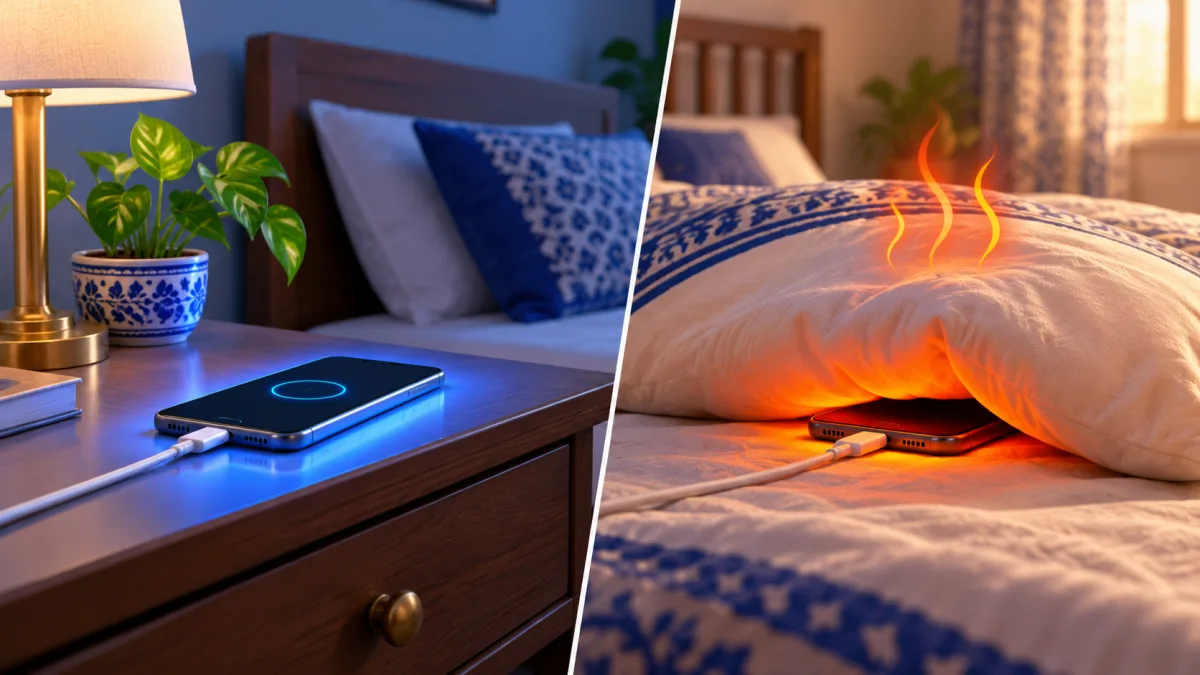
Heat wears a battery out faster than charging speed does, so never charge a phone under a pillow.
How to check if a Type-C charger is original
Fake "original" chargers are everywhere in India, from local shops to online listings, often priced well below the brand's own store. Six checks catch most fakes:
- Look for the BIS mark and R-number. Mobile chargers sold in India must be registered under BIS (standard IS 13252). The R-number is printed on the charger.
- Verify the R-number in the BIS Care app. Open "Verify R-No under CRS", enter the number, and check that the brand and product match, as the BIS Care app guide (opens in new tab) explains.
- Check the seller, not only the brand. On Amazon and Flipkart, tap the seller name. Prefer the brand's own storefront or a reseller with thousands of ratings.
- Compare the price. If an "original" charger costs half of what the brand's store charges, it probably isn't original.
- Check the build and print. Fakes often have blurry text, loose pins, a hollow light feel, or spelling mistakes on the box.
- Register the warranty. Genuine Samsung, Apple and Portronics products register with their serial number. A fake won't.
The same habits help with phones too; our guide on how to check if a phone is original or refurbished uses similar seller and serial checks.
What to check before buying a fast charger
- Which fast charger is best depends on your phone's protocol: PPS for Samsung, USB PD for iPhone and Pixel, the brand's own brick for OnePlus, Oppo and Xiaomi.
- A higher-watt charger is safe because the phone only takes what it supports.
- A 65W GaN charger with PD and PPS (from ₹1,099) is the best single charger for a home with mixed phones and a laptop.
- Samsung 45W and anything above 60W need a 5A cable.
- Fast charging doesn't meaningfully harm modern batteries; heat does.
- Check the BIS R-number in the BIS Care app before trusting an "original" charger.
Protocol first, watts second: our verdict
So, which fast charger is best? Match the protocol first, then the watts: PPS for Samsung, USB PD for iPhone and Pixel, the original brick for OnePlus, Oppo and Xiaomi, or one 65W GaN charger with PD and PPS for the whole family. Check the BIS R-number and the seller before you pay, and the charger will outlast your phone.
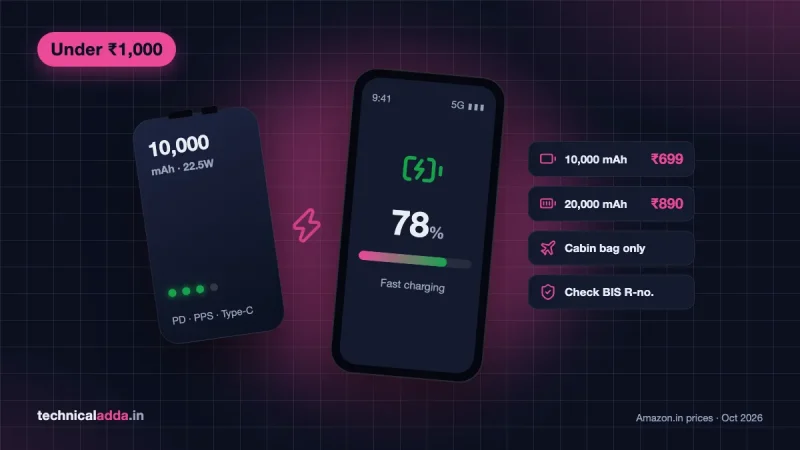
Need backup power for long days out? Read our picks for the best power bank under ₹1,000 next, or browse more buying guides in Smartphones and Gadgets.
FAQ
Frequently Asked Questions
Which fast charger is best for Samsung phones?
The best fast charger for Samsung phones is one with PPS, because Samsung's Super Fast Charging needs it. Buy Samsung's 25W adapter for Galaxy A and M models and the 45W adapter with a 5A cable for S Ultra and Plus models. A 65W GaN charger with PPS, such as the Spigen PE2302, also gives 45W on one port.
Is a 65W charger safe for a phone that supports 25W?
Yes, a 65W charger is safe for a 25W phone. The phone and charger agree on a voltage before charging starts, and the phone only draws the power it supports. You won't get more than 25W, but nothing gets damaged. Make sure the charger supports your phone's protocol, such as PPS for Samsung, or it will charge slowly.
Can I use a laptop charger to charge my phone?
Yes, if it's a USB-C charger that supports USB Power Delivery. Modern 45W to 100W USB-C laptop chargers negotiate a safe voltage with the phone, so they work like any fast charger. Old barrel-pin laptop chargers can't connect to a phone at all. Avoid unbranded laptop chargers without a BIS registration number.
What is the difference between PD and PPS chargers?
PD (USB Power Delivery) is the main USB-C fast charging standard and uses fixed voltage steps like 5V, 9V and 15V. PPS (Programmable Power Supply) is part of USB PD 3.0 and adjusts voltage in small steps, which keeps the phone cooler. iPhones need PD; Samsung's Super Fast Charging needs PPS. Good chargers support both.
Does fast charging reduce battery life?
Not by much. In HTX Studio's two-year test of 500 charge cycles, phones charged at 120W and 18W ended only about 0.3% apart in battery health. Heat and long hours at 100% wear batteries faster than charging speed does. Charge in a cool place and turn on your phone's 80% battery protection setting.
How many watts charger is good for a phone?
For most phones, a 25W to 33W charger is enough. Samsung A and M series take 25W, iPhone 12 to 16 take about 20W to 27W, and the iPhone 17 takes 40W. Buy the wattage your phone supports or higher. Going above it adds no speed but lets you charge a laptop or tablet with the same charger.
Why is my phone not fast charging with a new charger?
The usual reasons are a protocol mismatch, a weak cable, or a dirty charging port. A Samsung on a PD-only charger, or a OnePlus on a generic charger, charges at normal speed. A 3A cable limits Samsung's 45W mode. Clean the port gently with a wooden toothpick, try the original cable, and check fast charging is switched on in battery settings.
How can I check if my charger is original?
Find the BIS R-number printed on the charger and enter it in the BIS Care app under "Verify R-No under CRS" to confirm the brand and product. Then check that you bought from the brand's store or an authorised seller, compare the price with the brand's website, and register the warranty using the serial number.
Is GaN charger better than a normal charger?
A GaN charger is smaller, lighter and usually runs cooler than a silicon charger of the same wattage. That's why a 65W GaN charger can be the size of an old 20W brick. GaN doesn't charge your phone faster by itself; speed still depends on the wattage and protocol. Most good chargers above 30W now use GaN.
Where to buy
-
Check price on Amazon (opens in new tab)
Portronics Adapto 65M GaN: best value for most homes
-
Check price on Amazon (opens in new tab)
Spigen PE2302 65W GaN: best for Samsung flagships
-
Check price on Amazon (opens in new tab)
Samsung 25W and 45W Travel Adapters: safest for Galaxy phones
-
Check price on Amazon (opens in new tab)
Samsung 25W and 45W Travel Adapters: safest for Galaxy phones
-
Check price on Amazon (opens in new tab)
Ambrane 33W GaN: best budget fast charger
-
Check price on Amazon (opens in new tab)
Apple 20W and 40W adapters: for iPhone owners
-
Check price on Amazon (opens in new tab)
Apple 20W and 40W adapters: for iPhone owners